The Ulster County Charter does not direct the Comptroller to evaluate pending legislation, but our team does review all pending resolutions and local laws for their fiscal implication. This month, Resolution 2026-331 raises broader questions about transparency, public debate, and minority participation in government that warrant discussion.
Pending Resolution 2026-331 would change the number of legislators needed to bring a Petition to Discharge, which is a tool to bring a resolution directly to the floor of the Legislature even after it has failed in committee. Under current rules, three quarters of the number of the minority party must agree to bring a Petition to Discharge. Since the Republican minority is only 4 members at this time, they only need 3 legislators (of any party) to successfully bring a Petition to Discharge. This was recently used to bring to the floor Resolution 2026-232 which would have established the Ulster County Real Property Tax Phase-Out Feasibility Task Force.
I remember when the Ulster County Legislature was a Republican majority body with only 4 sitting Democratic members. The minority party struggled to get its voice heard and the result of one-party rule at that time brought us the Ulster County jail cost overruns. Although this change might make the process more efficient, I believe it limits minority voices where the legislative body is a super majority. With one Republican on each committee, as it is now, Republicans cannot move any proposal out of committee without significant Democratic support.
Committee meetings are important, but they rarely attract the level of public engagement received by a full legislative session. The Petition to Discharge process allows issues that have generated public interest to receive debate and consideration before the entire Legislature. I believe that silencing the minority in this way limits the diversity of opinion. One party rule is susceptible to group think and this proposal will severely curtail the ability to bring discussion.
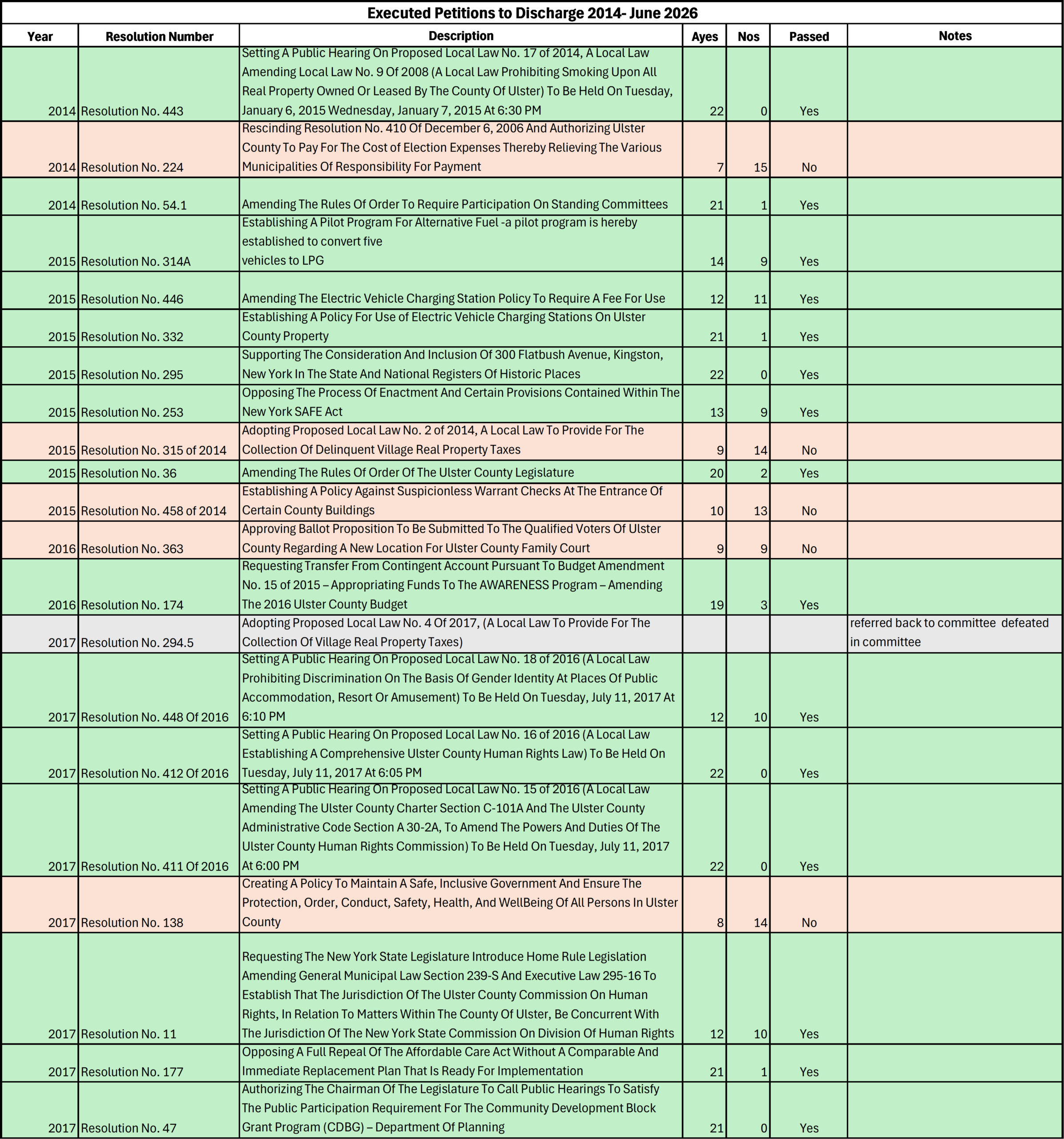
Ulster County has often seen the Petition to Discharge process be used to adopt common sense bipartisan legislation or communicate important information. We reviewed the Legislature’s database of resolutions for resolutions that had an attempt at a Petition to Discharge. Using the search term “Petition to Discharge” we are able to identify a total of 64 attempts at a Petition to Discharge. This list may not be exhaustive, but it is still instructive. Twenty of those Petition to Discharge attempts were not executed. Forty-four were executed. Of those that were executed, a high percentage of them receive approval by the Legislature and a significant portion of those resolutions pass by a unanimous vote.
The purpose of a Petition to Discharge is not to guarantee passage of legislation. Rather, it provides a mechanism for legislation that has generated public interest to receive consideration and debate before the full legislative body. The ultimate decision still rests with the majority of legislators.
Important policies and programs have been adopted through the Petition to Discharge process including requiring diversity training for elected officials, adoption of our local Human Rights Law, and the banning of smoking on County property. If the Legislature eliminates this mechanism, it will mean that there is one less tool to amplify diverse voices and re-address important issues that may have failed committee for a technical reason. Requiring a majority of legislators to bring a Petition to Discharge means you need all of your support lined up before you have the opportunity for debate on the floor. While the state operates by requiring a majority to bring forward legislation that failed in committee, Ulster County may decide that the state is not a model of legislative rules. Perhaps requiring a number of legislators based on the size of the body, not the size of the minority, for a successful Petition to Discharge would avoid having to line up a full majority to bring important issues to the floor.