
Currently at issue is the Ulster County Fair Taxes Act proposal (Resolution No. 2026-295). As the County continues to adopt deficit budgets that anticipate relying on Fund Balance appropriations, and we face impacts from federal cuts, I applaud the Executive and the Legislature for considering additional new revenue sources. While we don’t need this revenue today, we may need additional revenues in the 2027 and 2028 budgets or else we could see property tax increases.
I also like that this surcharge proposal is built upon a progressive tax structure, and by progressive here I mean a structure where those who earn more pay a higher percentage, rather than regressive taxes such as sales tax, which impact lower income people more because they pay a bigger percentage of their income on sales tax than wealthy people do. But I do have concerns about the thresholds and the consideration of the Ulster County Fair Taxes Act as a stand-alone measure. Let me explain why.
Concern 1: The tax begins at the upper middle-class levels of income
If you follow me on social media, you may have seen that I have often said some people need to have less, and we need to tax the ultra-wealthy, but none of those people golf at the local golf club. What I mean is that the majority of wealth inequity is occurring as the ultra-wealthy continue to accumulate vast resources at the expense of all others. There is a lot of confusion in the community about how the tax surcharge will work. A single person earning $300,000 will see about $1,500 in surcharge impact. The surcharge is 16.75% on the state tax liability generated by income earned above the threshold. State tax rates are set by the state and could change from time to time, impacting potential revenues from this proposal. Although the financial impact might be low for people and families over the threshold, the thresholds established create a wedge between those families in Ulster County who are moderately well off and everyone else when, in my opinion, the wedge should be driven between nearly all of us and the billionaire class.
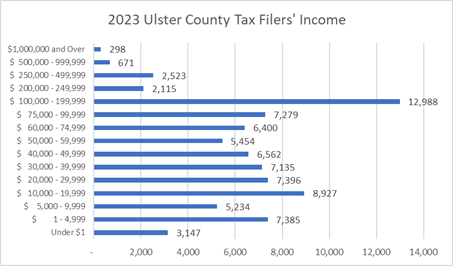
The thresholds chosen do not capture just the top 1% of filers, but indeed the top 3.3-3.8% of filers. The data available from the IRS and NYS Tax and Finance is dated and has limitations for purposes of analyzing the impacts of this proposed legislation, nonetheless, we can draw certain conclusions from it. Many taxpayers are in the $200,000 – $249,999 income range, but we assume that their overall income tax liability and the commensurate surcharge would result in a trivial portion of the proposed revenues. The latest data available to us is 2023 NYS Income tax return data. If inflation trends continue to drive wage growth, we believe that 2026, 2027, and 2028 could see many more filers pushed from the $100,000-$199,999 income range into the over $200,000 income range. Will the income ranges included in the surcharge increase with inflation over time? The law as proposed has no mechanism to facilitate this.
Concern 2: The tax may send a negative message to some
There is a split in the literature about whether tax increases actually do cause outmigration. The chosen threshold of $200,000/$400,000 may dissuade certain professionals from making residence in Ulster County. For example, we have a hard time recruiting doctors to Ulster County. This legislation will not help. We would be better served by seeing major tax reform at the federal and state levels which I recently called for in a City & State op ed with two other county comptrollers. Since state income tax is largely based on federal income tax, what we need to bring tax fairness is major federal income tax reform that closes loopholes exploited by the ultra-wealthy without creating a patchwork of tax laws among counties and states that could result in people moving for tax purposes.
Concern 3: Discussion of a new income tax is taking place in a vacuum
Another concern is the consideration of this proposal without a broader discussion on the table. We are not facing an imminent risk to the County’s finances, but we are anticipating hard times ahead. I understand that it takes time to get a proposal like this fully adopted, however, since the state legislature will not take up the measure until next year, we do have time for a broader discussion. I have heard from constituents who would never pay this tax themselves yet remain concerned that the County may be considering new revenue sources before thoroughly evaluating spending and identifying potential efficiencies within the budget. There really haven’t been discussions in the budgetary context of cuts in light of the potential changes in federal funding which could increase Ulster County taxpayer responsibility for SNAP and Medicaid costs. There are also other potential revenues that we might want to consider such as a real estate transfer tax which could be targeted at high-value property transfers. It would be good to consider these issues together so policy makers could weigh various revenue sources and cuts against each other and develop a long-term comprehensive approach.
Concern 4: The proposed law is not contingent on certain financial outcomes
While I applaud the pursuit of new revenues, tying those revenues to a distinct need would protect taxpayers. For example, we could consider triggering an income tax surcharge should the County’s Medicaid weekly share increase or should the state SNAP benefit error rate remain above 15% in 2027, which would cost Ulster County taxpayers at least an additional $6.2 million annually. During the Great Recession, Ulster County’s sales tax revenues declined 8%. We could consider triggering this new revenue for the following tax year contingent on a specific reduction in sales tax.
The state bills for this proposal A11460/S10532 do contain the local ability to add a sunset provision, but the County proposal has not included discussion of an end date or the requirement for regular reauthorization. We may want to consider a way to undo the provision if times are flush and federal cuts do not have the negative impacts we anticipate.
Just to summarize, I applaud those who are looking for new revenues as we face pending federal cuts. We must thoughtfully consider reductions in spending as well as new revenues. If this proposed act can be amended, I recommend raising the income threshold and tying the new revenues to specific expenditures or reductions in more regressive taxation structures. I agree that we need to tax the ultra-wealthy and I recommend that we do this at the federal level to have the best impact and avoid tax migration.